
Peter Piper picked a peck of pickled… pee-pee-PEE?
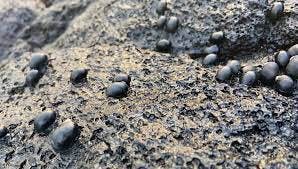
Probably one of the easiest Hawaiian words to pronounce, pipipi sounds as phonetically as it looks. They’re those tiny black snails that stick to rocks along Hawaii’s shorelines, usually between the high and low tide lines. They can also be found in ocean tide pools or rocky areas where waves constantly crash.
Although they’re also known as Nerites, most people in Hawaii call them pipipi, which means “small and close together” in Hawaiian. And appropriately so, as these half-inch snails usually spend their days crowded together in clusters. The ones you see on the rocks are most likely adults because after maturing in the ocean, they hike to the shoreline, where they eat and reproduce.
While most pipipi are black with spiral grooves, there’s actually one species native to Hawaii that is set a part by its colored spots. The spots can be white, yellow, pink, orange, red or black. This special type of pippi, called kupee, grows to be an inch long. Ancient Hawaiians used these particular snails to make bracelets and necklaces. Today, jewelers continue to use pipipi for their crafts.
The kupee species is one of nine that are native to Hawaii waters. The tiny flap on its underside is actually a gill that extracts oxygen from the sea, from fresh or brackish water and from the air (when on the rocks). During the day, they’re snuggling, but at night is when they’re most active and eating algae.
I remember helping my dad pick pipipi when I was younger. We’d come home with a gallon-size bag of the tiny snails, which my mom would immediately wash and throw into a sizzling pan of garlic butter. Being the picky eater I was back then, I wouldn’t dare try them. But my family seemed to enjoy its taste.
I’ve also heard of other families eating them raw or making pipipi soup. Ancient Hawaiians believed it was not good for a pregnant woman to crave the snails because eating pipipi might lead to her child having makapipipi, or beady eyes. Older Hawaiians did not think this to be an admired trait.


